
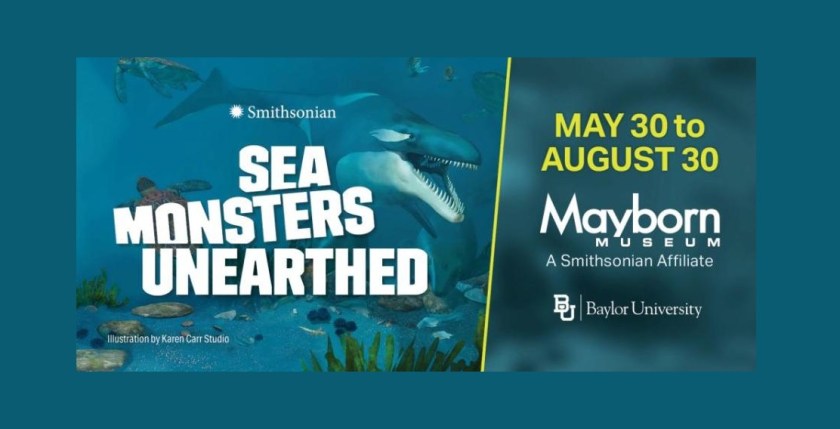
I’ve always enjoyed visiting the Mayborn Museum down in Waco, Texas. It’s on the smaller side, but it certainly has its charms, and has a large space for temporary exhibits. It’s the latter feature that concerns us today, as they recently hosted an exhibit called Sea Monsters Unearthed, a traveling exhibit all about prehistoric sea reptiles.
More specifically, it focuses on the Cretaceous sea life from the coast of Angola, where significant excavations have uncovered a whole prehistoric ecosystem from the rugged coastline. This effort, known as Project PaleoAngola, involved the collaboration of an international team of paleontologists, with some of the prize specimens making their way into this exhibit. Sea Monsters Unearthed was organized for travel by the Smithsonian, with much of the fossil preparation conducted by staff and students at Southern Methodist University in Dallas, Texas.
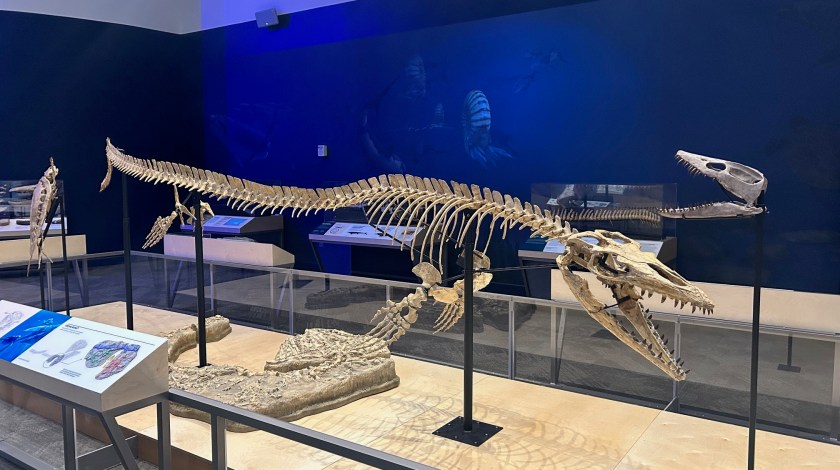
The reconstructed skeleton of a 23-foot mosasaur Prognathodon is the star of the exhibit, which floats above a cast of the rocky matrix in which it was originally found. This matrix further preserves three additional mosasaurs in the belly of Prognathodon, the apparent victims of serial acts of cannibalism! Various other fossils surround the skeleton, as well as photomurals and video vignettes that inform visitors about the fieldwork that went into discovering these ancient sea beasts.
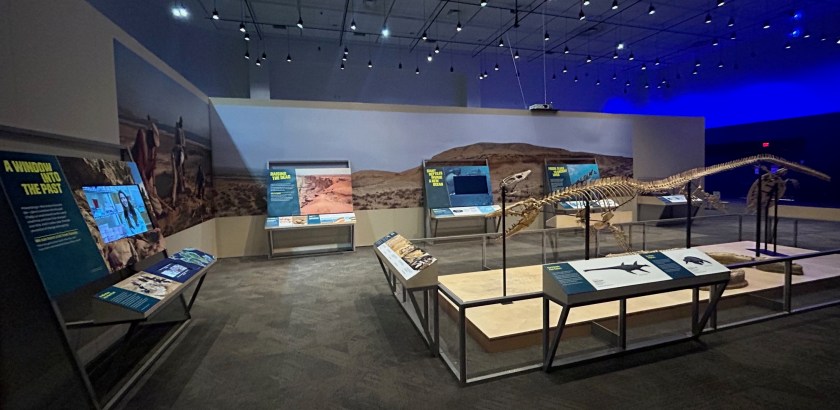
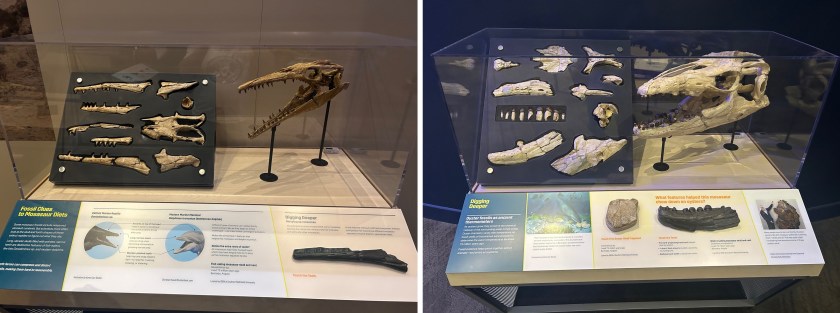
The base “Sea Monsters Unearthed” exhibit focusing on Angolan fossils is somewhat small, at least for the Mayborn Museum’s large temporary exhibit space, filling up only about half of it. Therefore, the Mayborn teamed up with Southern Methodist University to fill out the other half with fossils from SMU’s collections found right here in Texas. This gives visitors the unique opportunity to compare and contrast fossils from either side of the Atlantic Ocean, providing them with a fuller picture of the Cretaceous seas.
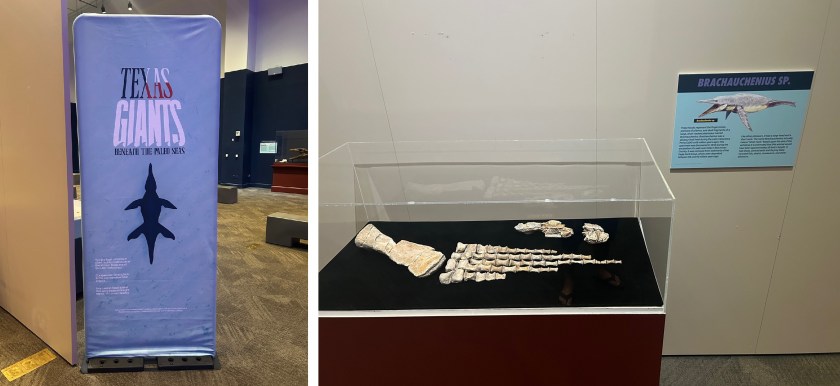
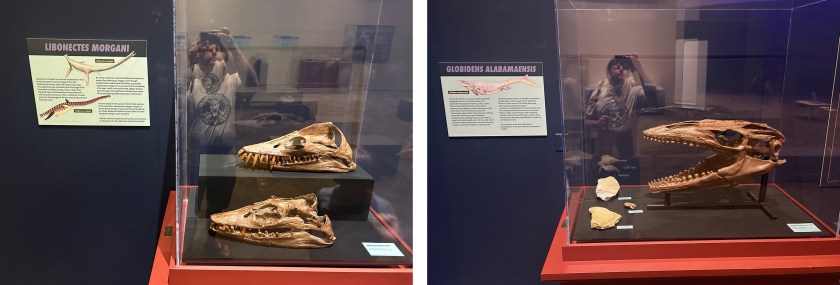
“Sea Monsters Unearthed” has already traveled to a few other museums, and is scheduled to appear next at the Flint Hills Discovery Center in Manhattan, Kansas this fall. For now though, guests can continue to see it at the Mayborn Museum through August 30th, 2026. I highly recommend you do if you’re anywhere in the area! While the base exhibit was fun to see, I doubt the Texas material will be following it to its next destination, so you’re likely to get a bit more bang for your buck while it’s here. For an excellent book on prehistoric sea life, check out my review of Ancient Sea Reptiles. For similar attractions, check out my review of the rest of the Mayborn Museum, as well as other nearby Texas museums (including the Fort Worth Museum of Science and History, the SWAU Dinosaur Science Museum, Dinosaur Valley State Park, and Texas Through Time).

