
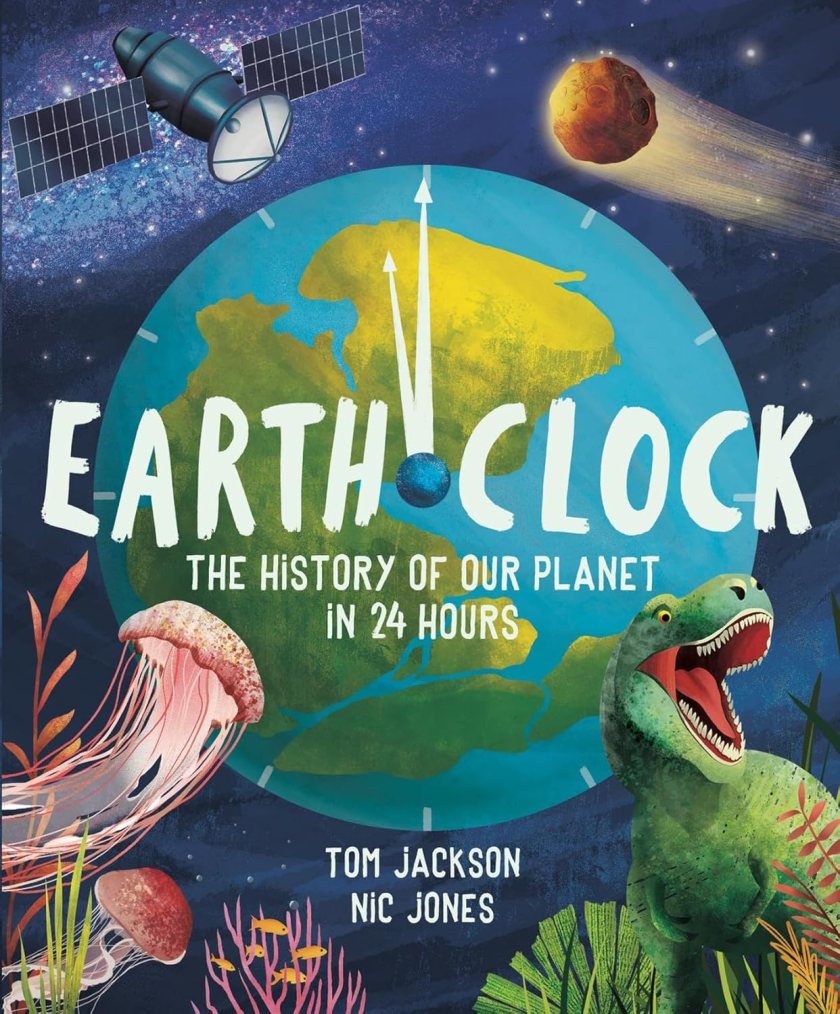
Here’s a fun book called Earth Clock: The History of Our Planet in 24 Hours, which, as the title suggests, is a book about Deep Time that maps the major events of the history of Earth onto a 24 hour clock. The concept of condensing the 4.5 billion year history of the Earth into a smaller, more digestible format is not exactly new, though I think I’ve seen a calendar analogy more often than a clock one.
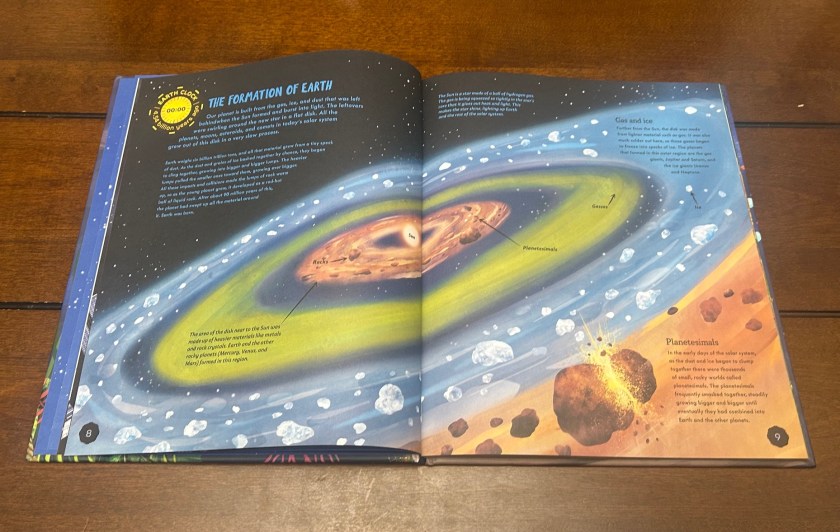
Written by Tom Jackson and illustrated by Nic Jones, Earth Clock begins (naturally enough) at 00:00 hours with the formation of the Earth 4.54 billion years ago, and continues on through the modern day at 24 hours. The author introduces readers to many significant developments along the way, with the relative time shown on the clock on the upper left hand side of the page.
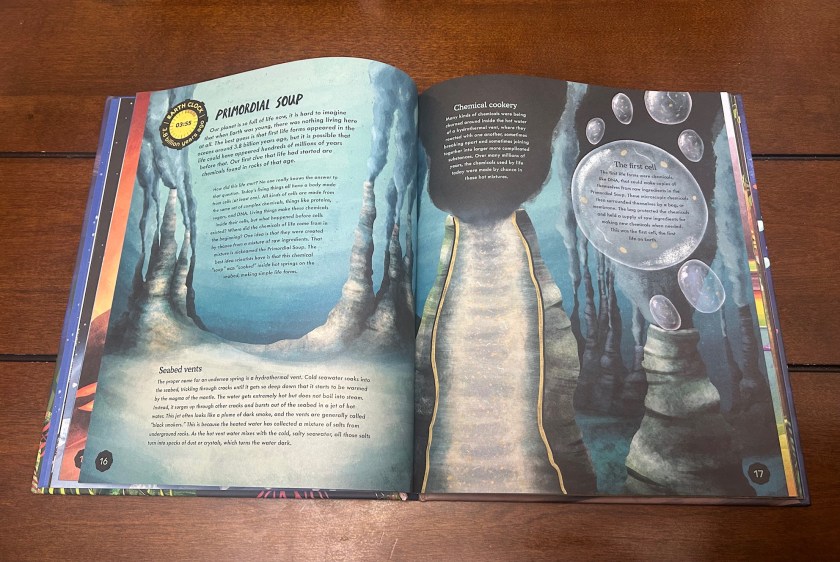
The author doesn’t just on the popular creatures of the Phanerozoic Eon, either. While other books might speedrun through the Precambrian, this book includes 11 spreads (nearly half the book) on the development of Earth during this period, including the formation of the Moon, the Late Heavy Bombardment, and the origin of life. It really emphasizes just how long the Precambrian was, seeing how much of the time on the clock that it takes up.
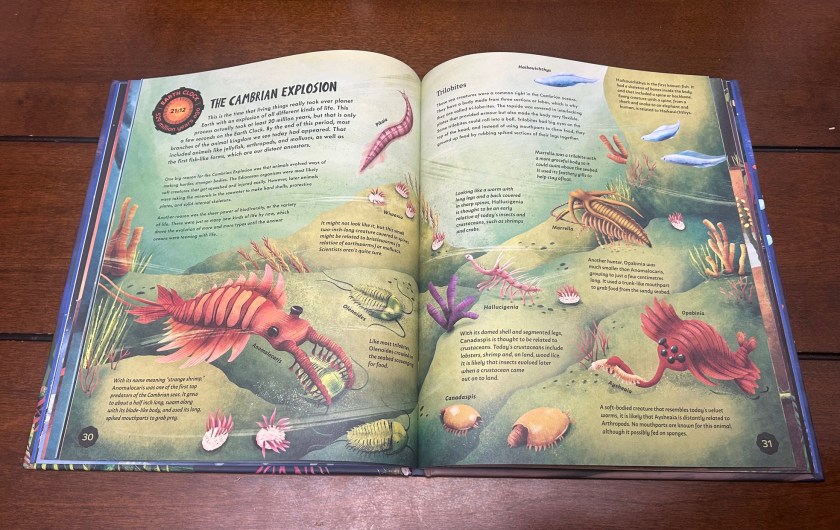
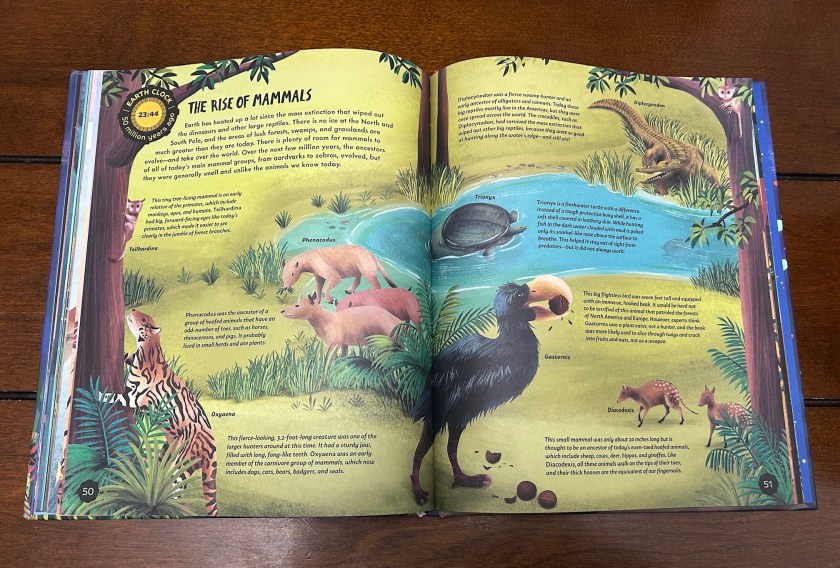
While stylized, the illustrator provides reasonably accurate paleoart, and generally does right by the species depicted. There’s a fair amount of creatures depicted, too, from Paleozoic creepy crawlies, to the might dinosaurs of the Mesozoic, and the ancestors of modern animals in the Cenozoic.
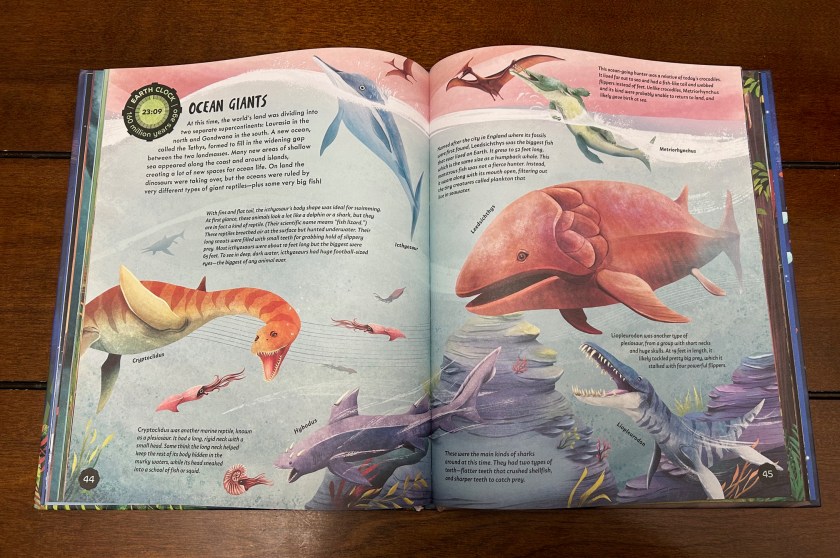
The information presented seems to be pretty accurate for the most part, though I did note a couple of goofs. Anomalocaris is incorrectly stated to be only half an inch long, while in reality it was between 1-3 feet long depending on the species. When discussing hoofed mammals (ungulates), pigs are twice incorrectly grouped with odd-toed ungulates instead of even-toed ungulates.
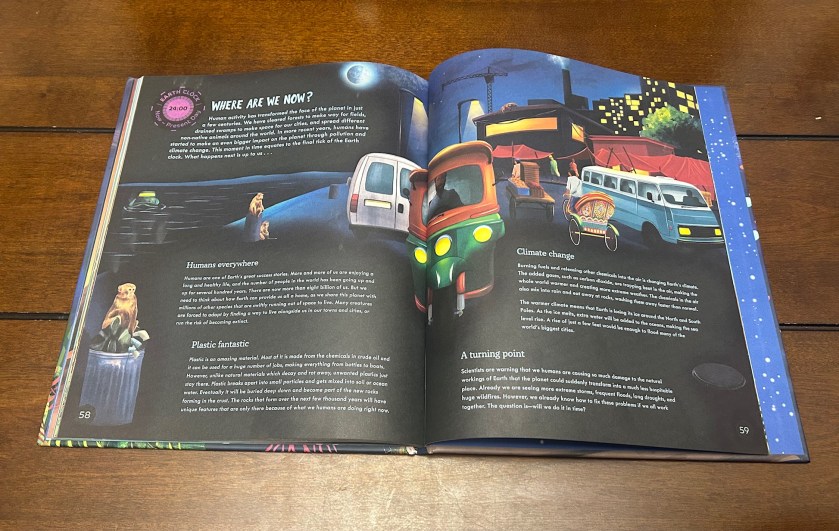
The last few pages discuss the modern era, and the challenges we face in the present and the future. Human-caused pollution and climate change are discussed, with a few of the potential consequences mentioned. My younger son says he liked these pages best, because they explain how we can thrive in the next “seconds” on the clock.
I always appreciate a good book on Deep Time, and I liked the visual of the clock counting away the “minutes and hours” of Earth’s history. My kids particularly enjoyed this one, to the point that my youngest decided to help me with parts of this review! I would definitely recommend this book for others interested in prehistory, and I give it my Dino Dad Stomp of Approval. For other books about Deep Time, check out my reviews of A Brief History of Life on Earth, Life: The First Four Billion Years, and Dinosaurs: Exploring Prehistoric Life and Geological Time.


I helped with this one.
LikeLike