
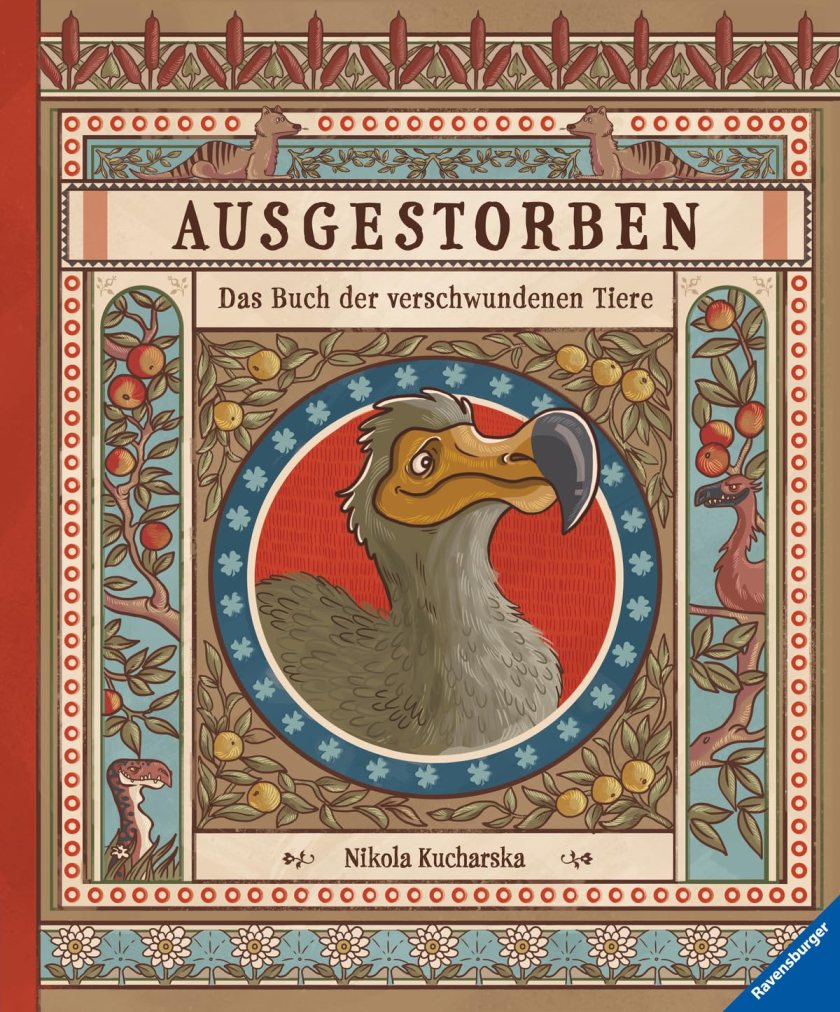
I like to feature something a little different once in a while here at Dino Dad Reviews. I’ve featured a few non-English-language books before, including ¡Más te vale, Mastodonte! and Dinosaurios Bebés in Spanish, and Europasaurus with its side-by-side English & German text. I wanted to try and brush up a bit on my German, and so to that end I purchased myself a copy of Ausgestorben – Das Buch der verschwundenen Tiere. (That translates into “Extinct – the Book of Vanished Animals” in English.) As it turns out, this book was not originally written in German, but rather in Polish as Zwierzęta, które zniknęły (or “Animals That Have Disappeared”). Oh well, I can still practice my German with this edition anyway!
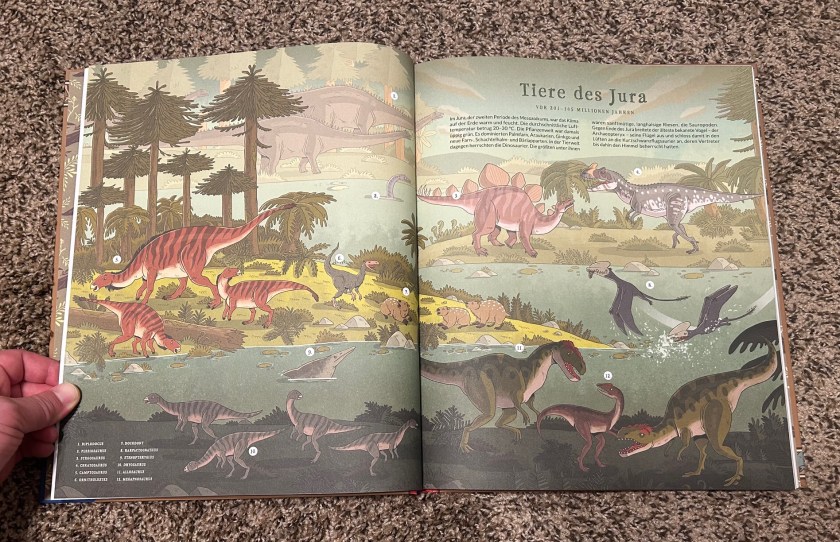
Illustrated by Nikola Kucharska and authored by Katarzyna Gładysz, Joanna Wajs, & Paweł Łaczek (I suppose the names should have clued me in to its Polish origin!), Ausgestorben features extinct animals of all stripes, from the Devonian to the modern day. The format and subject matter strongly remind me of a combination of Small and Tall Tales of Extinct Animals and Fossils From Lost Worlds.
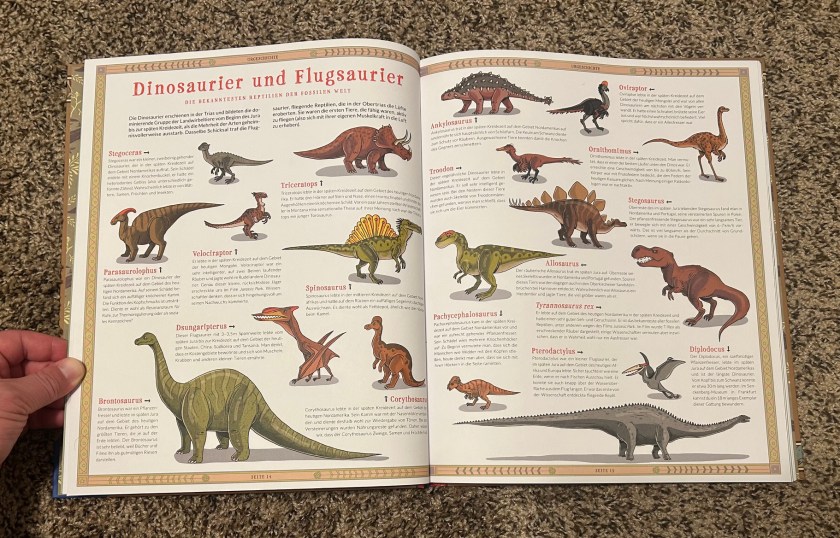
The book is loosely arranged in a vaguely chronological order, roughly tracing the evolutionary history of tetrapod animals. Beyond that, though, there’s not a clear organization scheme to the book. It alternates between creature profiles, time period overviews, and other topics, doing so somewhat randomly. I wouldn’t go so far as to call it disorganized, just maybe a little haphazard.
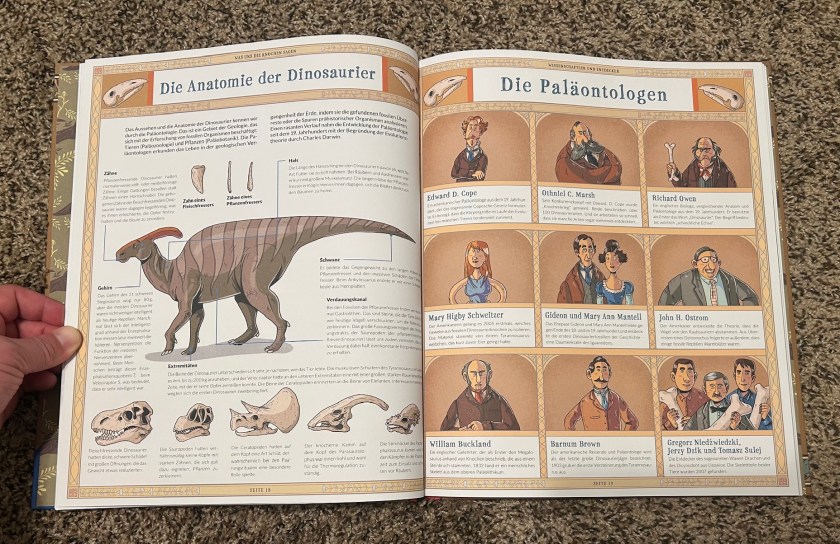
I do rather like the art style; Kucharska illustrates her subjects in cartoons with a lot of character. The style works particularly well for the mammals, birds, and humans, though the depictions of dinosaurs and other reptiles can occasionally appear somewhat distorted.
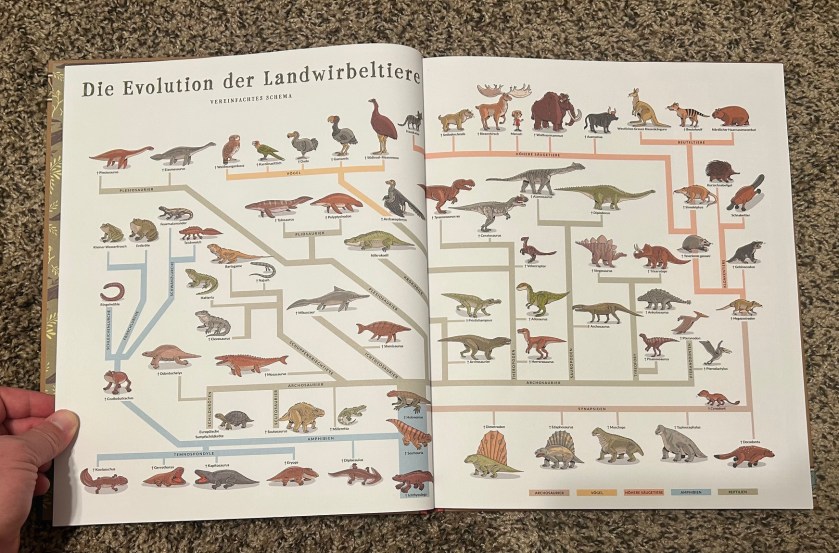
As best as I can tell with my fuzzy recollection of German, the information presented seems generally accurate. I did however notice a significant typographical error in the evolutionary tree at the beginning of the book; namely, it got confused by all things “Archosauria”. The term “Archosaurier” appears in three places on the tree: once in its correct spot, once where it should have read “Reptilien”, and once as the name of a specific animal, rather than a group. (Based on the similarity to an illustration elsewhere in the book, I think this last one was meant to be a Postosuchus.) Archosaurus itself also appears on the family tree, but as the ancestor to sauropods, rather than to all archosaurs.
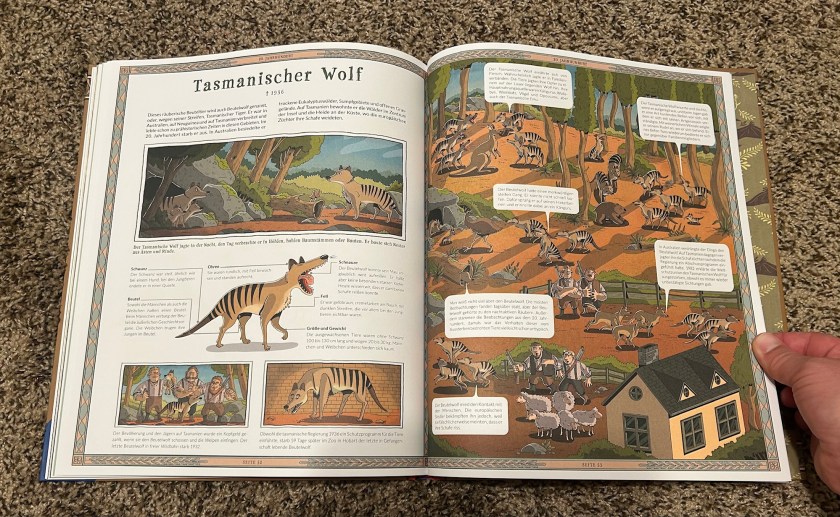
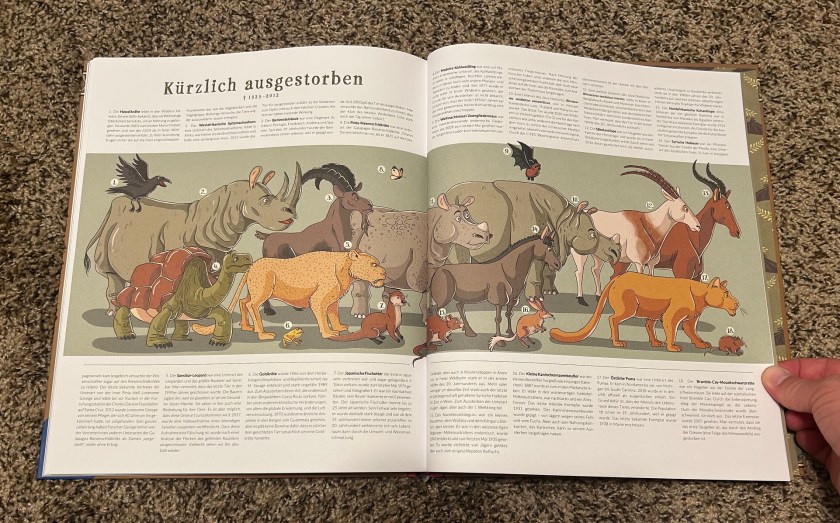
The second half of the book focuses on recently extinct animals, highlighting the role that humans have played in their demise. This brings a welcome conservation focus into the book, which is a topic that can never get too much attention.
I rather like Ausgestorben, even with some of my criticisms. It is detailed, pleasantly illustrated, and broad in scope. I would enjoy seeing an English language version at some point, so it can reach an even wider audience. I would certainly recommend it to anyone who happens to speak German or Polish! Give it a look if you get the chance.
 Dino Dad Reviews