
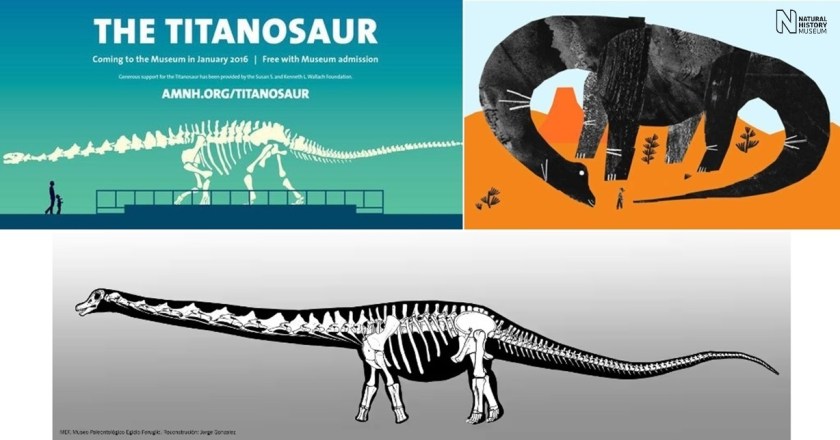
I recently had the privilege of visiting both the American Museum of Natural History in New York and the Natural History Museum of London within a few days of each other, as I traveled to attend TetZooCon 2023. Knowing that they both possessed more or less identical casts of the mighty Patagotitan, this seemed to present a fantastic opportunity to compare how two different museums approached the same topic, and so I decided to make a mission out of it!
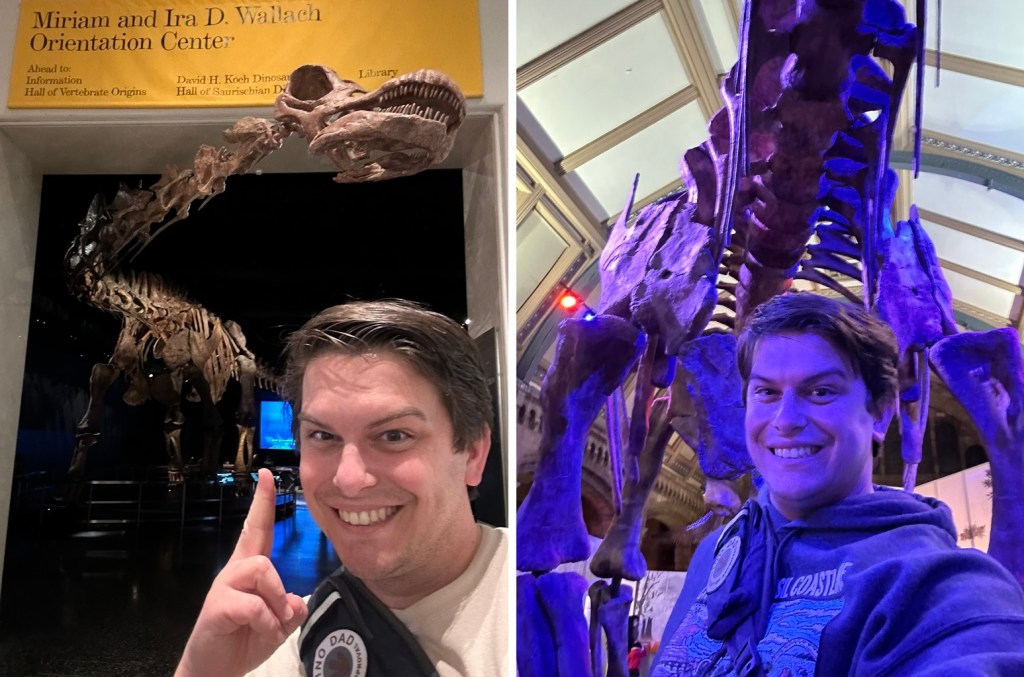
Both the AMNH and the NHM are historic institutions with deep involvement in the development of paleontology as a science, and seeing both so close together left me sort of starstruck, but hopefully my ability to assess these two exhibits in particular remains intact!
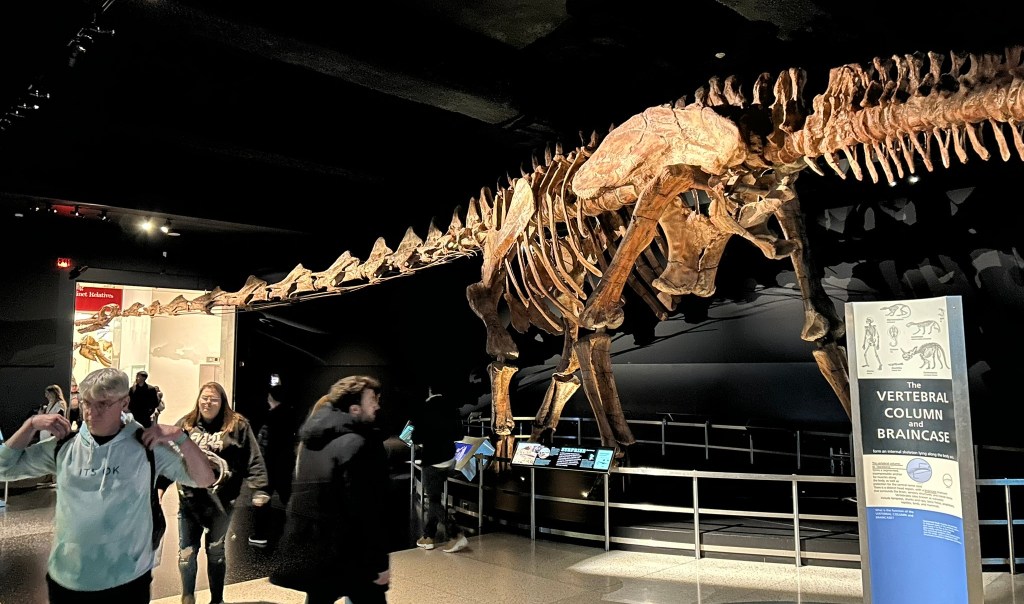
I visited the AMNH first, on an extended layover before my transatlantic flight. The Titanosaur here sticks its head out of the door to its exhibit space, and into the hallway outside. Inside it is moodily lit: most of the room is dark, with soft yellowish lighting on the dinosaur itself. It has as few informative plaques surrounding it, a couple supplementary display on its left side, and a documentary short film which I didn’t sit completely through, but seemed to mostly cover evolution and the study of taxonomic families.

While the dramatic lighting certainly is impressive, I’m not the first to point out that it’s very difficult to get a decent picture of the front half of the animal, what with the way it sits partially in and out of the room. I also couldn’t help but think the overall space was rather underutilized. Perhaps I was misinformed by the reference to this exhibit in The Dinosaur Expert, which led me to believe I would be able to see other creatures discovered in the same region as Patagotitan, such as Gasparinisaura, but no such luck, there.

As it turns out, London raised the bar with their exhibit, Titanosaur: Life as the Biggest Dinosaur. It builds anticipation by hiding the skeleton away from the exhibit’s entrance, and guides visitors past several stations all about Patagotitan and the world it inhabited. This includes some original fossil material, as opposed to the casts used for the main skeletal mount.
The bulk of the information stations have visitors following the life cycle of Patagotitan, from hatching, to avoiding predators, finding food, and finally reaching full, adult size. There’s a high level of interactivity to these stations. While many of them are screens, which I am normally hesitant to approve of, it’s all very integrated into the exhibit, and designed to guide visitors along towards additional informative screens and panels. Color me impressed with the intentionality here, as it is very easy to fall into the trap of designing these sorts of things in a way that simply distracts kids away from the actual exhibits. This level of integration extends beyond the Titanosaur exhibit itself, too, with the children’s book of the same name that earned my Stomp of Approval recently. That’s a level of intentionality in the merchandising that many museum gift shops similarly often miss!
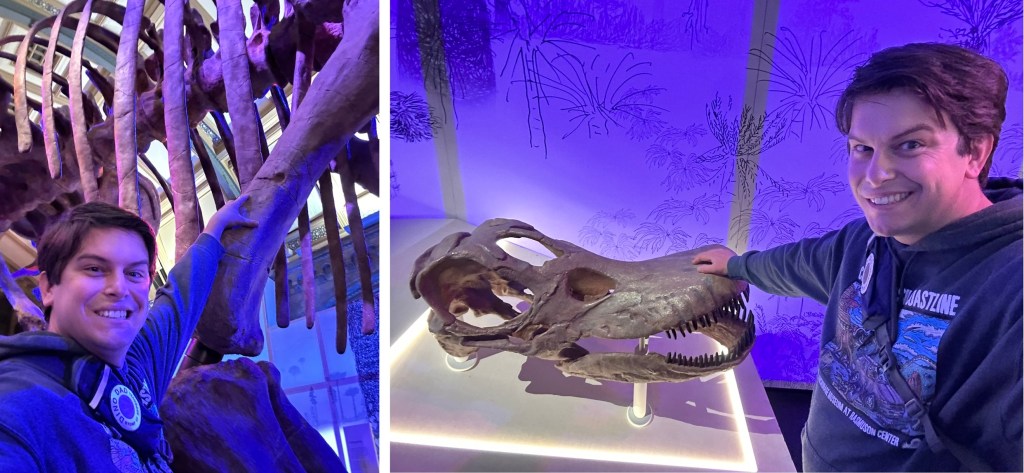
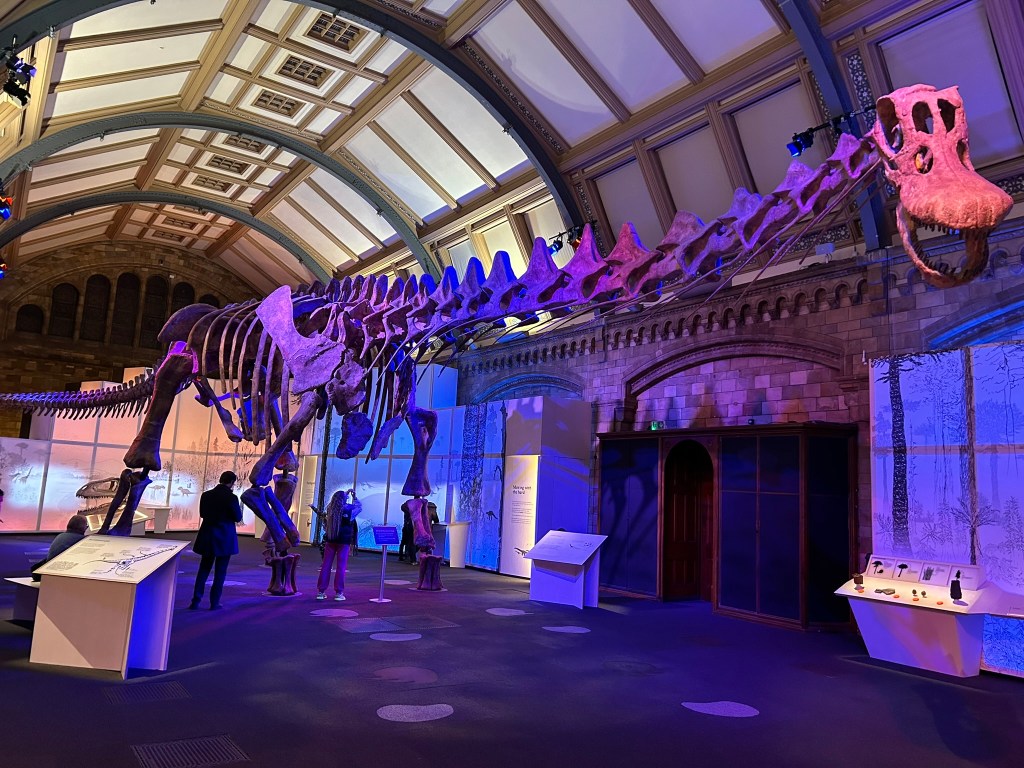
The final life stage station of the exhibit emphasizes the incredible growth rate that young sauropods underwent, right before turning visitors around for a rather dramatic reveal of the main attraction. The skeleton itself is similarly posed to the AMNH one, though mirrored, and it is MUCH easier to get a decent picture of it, even if the bisexual lighting is a bit dim and made for grainier images on my phone’s camera. One brilliant touch is… well, touching! The skeleton stands right on the main floor, rather than up on a pedestal or behind rope, allowing visitors to walk underneath it, and even touch its massive bones! This definitely goes a long way towards emphasizing its sheer size relative to the viewer. Several additional casts are brought down to guest level, such as a copy of the skull, for viewers to examine in closer detail.
While the AMNH set an important precedent, (“they walked so others could run”, so to speak.), I think the NHM comes out the clear winner in a comparison between the two. The biggest downside to the NHM’s version is that it was explicitly intended to be a temporary exhibition, and has already closed down its run in London. It WILL be going on tour, though I am unaware of what its future stops may be. Keep an eye out for it, and it may show up near you soon! (Hopefully I will also be able to visit the Patagotitan on display at the Field Museum someday, though as it simply kicked Sue upstairs and took her former pedastal in the main atrium, I feel like there’s less to be said about its presentation, other than having even better visibility than either of the other two.)
If you want a to get a sense of the NHM Patagotitan in the meantime while it is between destinations, check out Acheroraptor & Edaphosaurus‘ video about their visit to it. I personally feel that their video tour gives a far better sense of the overall exhibit than I could ever give through text alone!
If you’re interesed in the history of Patagotitan’s discovery and excavation, I highly recommend Titanosaur: Discovering the World’s Largest Dinosaur. As I mentioned before, I also enjoyed the tie-in book for the London exhibit, Titanosaur: Life as the biggest dinosaur. While not necessarily “about” the AMNH exhibit, that version does serve as a key plot point in The Dinosaur Expert, which tells a tale that I’m sure all shy dinosaur nerds like myself can relate to. On a slightly less related note, I’ve also reviewed Dippy: The Nation’s Favourite Dinosaur, a book about the former star sauropod of the NHM. Happy reading, and I hope you enjoy either of these exhibits if you get the chance to visit, whatever the pros and cons of each of them!
 Dino Dad Reviews
Useful post, thank you! But what did you mean by “bisexual lighting”?
Myself, I’ve not seen either the AMNH or NHM exhibitions — but I have seen the same cast in the Field Museum in Chicago, and it’s really magnificent. It needs that kind of big, wide-open, naturally lit space. I’m confident I’ve seen it in its best form.
LikeLike
Oh, it just became a whole meme at one point pointing out how often pink/purple/blue lighting was being used in movies. It started out as a genuine discussion of symbolic intent, but quickly became somewhat less meaningful as any instance of those colors was jokingly called “bisexual lighting”.
https://knowyourmeme.com/memes/bisexual-lighting
LikeLike