
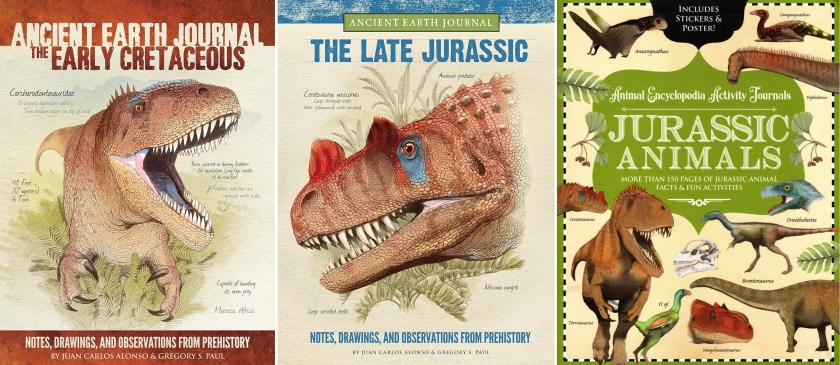
For this review, I thought I would do something a little different and look at a set of books all together. This sharp-looking book series is one I’ve been meaning to get to for a while, but for one reason or another just kept getting pushed to the side. So let’s finally rectify that by examining the Ancient Earth Journal series, by Juan Carlos Alonso & Gregory S. Paul.

Yes, THAT Greg Paul. If you’re a certain caliber of paleonerd, Greg Paul needs no introduction. Other than Bob Bakker himself, perhaps no other single person had as much of an influence on the vaunted “Dinosaur Renaissance” that pulled dinosaurs up out of the swamps, and into their rightful place as the ancestors of birds. I’m unsure of Paul’s actual contributions to this series, however. Juan Carlos Alonso is listed as both author & illustrator, while Paul is listed merely as co-author, and indeed, all illustrations are exclusively from Alonso’s portfolio. Not even a single one of Paul’s famous skeletal reconstructions appear in the series, and there’s no indication who exactly wrote what, either. A part of me strongly suspects Paul was included exclusively for clout, though I’ll get more into why in a bit.

The Ancient Earth Journal series includes books on the Early Cretaceous and the Late Jurassic, as well as an activity book. Alternate editions of both the Cretaceous & Jurassic books also exist that split each of them in two, though I fail to see any real reason to do so. The two main books are presented in a field note/journal format, but similarly to Dinosaurs! Explorer and its respective series, it doesn’t feel like they fully commit to the premise.
Ancient Earth Journal: The Early Cretaceous
The Early Cretaceous volume saw publication first, and covers several iconic animals from this time period, arranged alphabetically within family group as follows:
- Theropods: Acrocanthosaurus, Baryonyx, Carcharodontosaurus, Concavenator, Microraptor, Scipionyx, Utahraptor, & Yutyrannus
- Sauropods: Amargasaurus, Argentinosaurus, Nigersaurus, & Sauroposeidon
- Ornithischians: Gastonia, Iguanodon, Ouranosaurus, & Psittacosaurus
- Pterosaurs: Anhanguera & Tapejara
- Early Birds: Confuciusornis & Enaliornis

I was enamored by Juan Carlos Alonso’s illustrations when this came out, and the information presented is generally decent, however a few aspects have since started to stand out to me. First and foremost, I consider it a major science communication blunder to list “birds” separately from “theropods”. Birds ARE in fact theropod dinosaurs, and listing them after pterosaurs implies that birds are somehow separate from their own close relatives. Even if the author really wanted to list them separately in order to emphasize their importance, they should have at least been placed immediately after the theropod section, before sauropods. This formatting makes Greg Paul ‘s supposed influence seem minimal, as one would think that Mr. Dinosaur Renaissance himself would want to emphasize this connection as well.
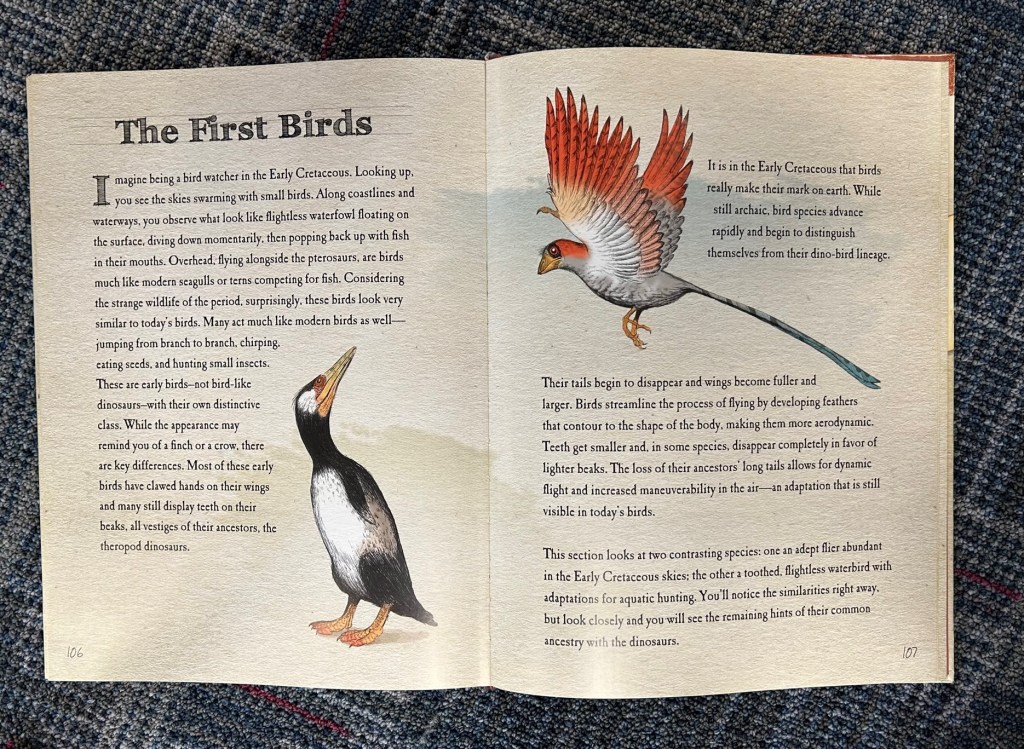
On a slightly less important note, while there’s certainly a decent range of dinosaurs depicted, there’s still something that feels a little unbalanced about it. There are about as many theropods as any other type of creature in the book, for one thing, but for a supposed field journal, it feels like there’s a bit of a lack of herbivores in general. I note that Pelicanimimus is illustrated as prey for Concavenator, but not given its own profile, and while it happens to be another theropod, it would’ve been nice to learn more about this interesting looking ornithomimid. I would have appreciated the inclusion of additional ornithischians even more, though. There’s always more unique ankylosaurs to feature, and I have no doubt that Alonso could have overcome the stereotype that early ornithopods were all kind of “same-y”. Tenontosaurus, for example, had an unusually long tail, and would have made a nice companion to the Acrocanthosaurus, Utahraptor, and Gastonia.
Ancient Earth Journal: The Late Jurassic
Formatted in the same way as its predecessor, the Late Jurassic entry brings more of Alonso’s excellent illustrations, and generally decent information. The species are covered, again alphabetically, as follows:
- Theropods: Allosaurus, Archaeopteryx, Ceratosaurus, Compsognathus, Guanlong, Ornitholestes, Torvosaurus, Yanghuanosaurus, & Yi qi
- Sauropods: “Brontosaurus louisae”, Camarasaurus, Diplodocus hallorum, & Giraffatitan
- Ornithischians: Camptosaurus, Gargoyleosaurus, Kentrosaurus, & Stegosaurus
- Pterosaurs: Anurognathus & Rhamphorhynchus
- Mammals: Shenshou & Juramaia
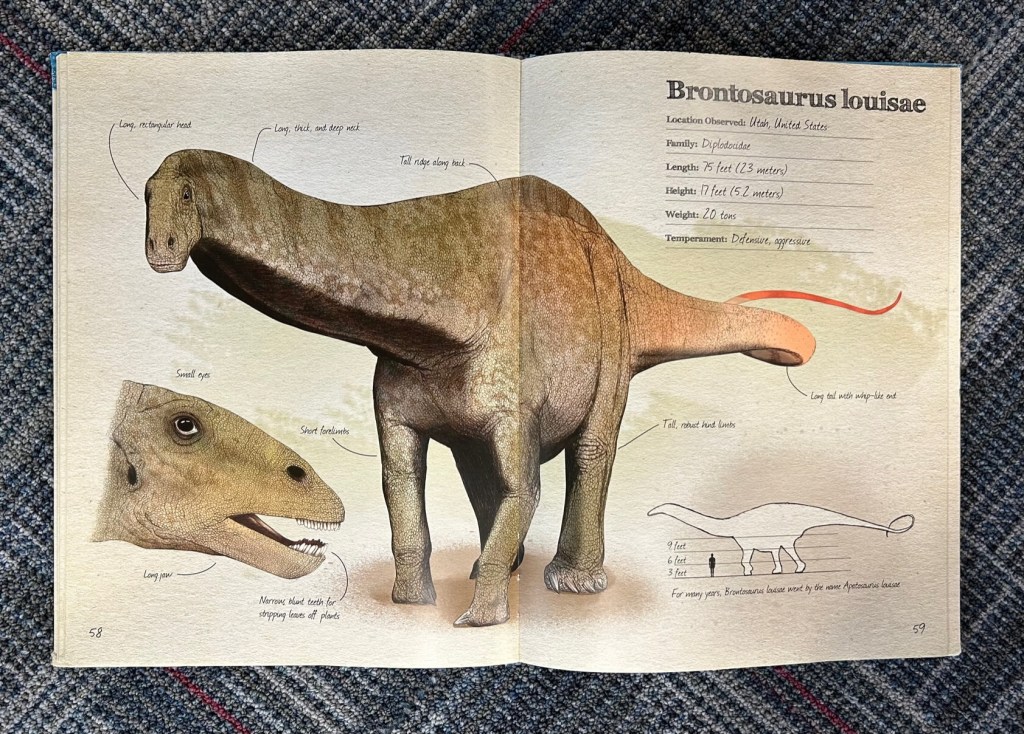
While one could perhaps argue my main criticism of the previous book might come down to a matter of opinion, unfortunately the blunder I found in this one is more definitive. I might as well just flatly state that the idea of a “Brontosaurus louisae” is wrong on multiple levels. While, as mentioned in Ted Rechlin’s Jurassic, the genus Brontosaurus has indeed been re-split from Apatosaurus and is thus once again valid, the type species known under that genus was always B. excelsus. The species known as “louisae” remains under the genus Apatosaurus, as it always has been. Yet again, this appears to be evidence of Paul’s minimal involvement, as he is infamously a stickler for zoological nomenclature, and likely would have caught this. His scientific writings are the reason this book features Giraffatitan rather than Brachiosaurus, after all.

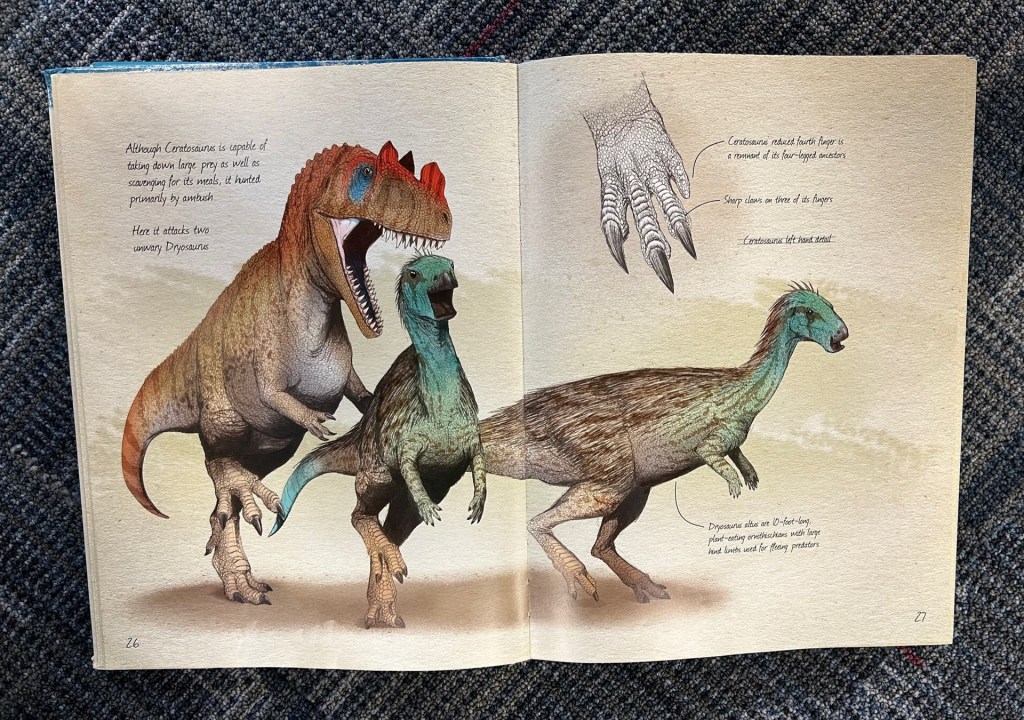
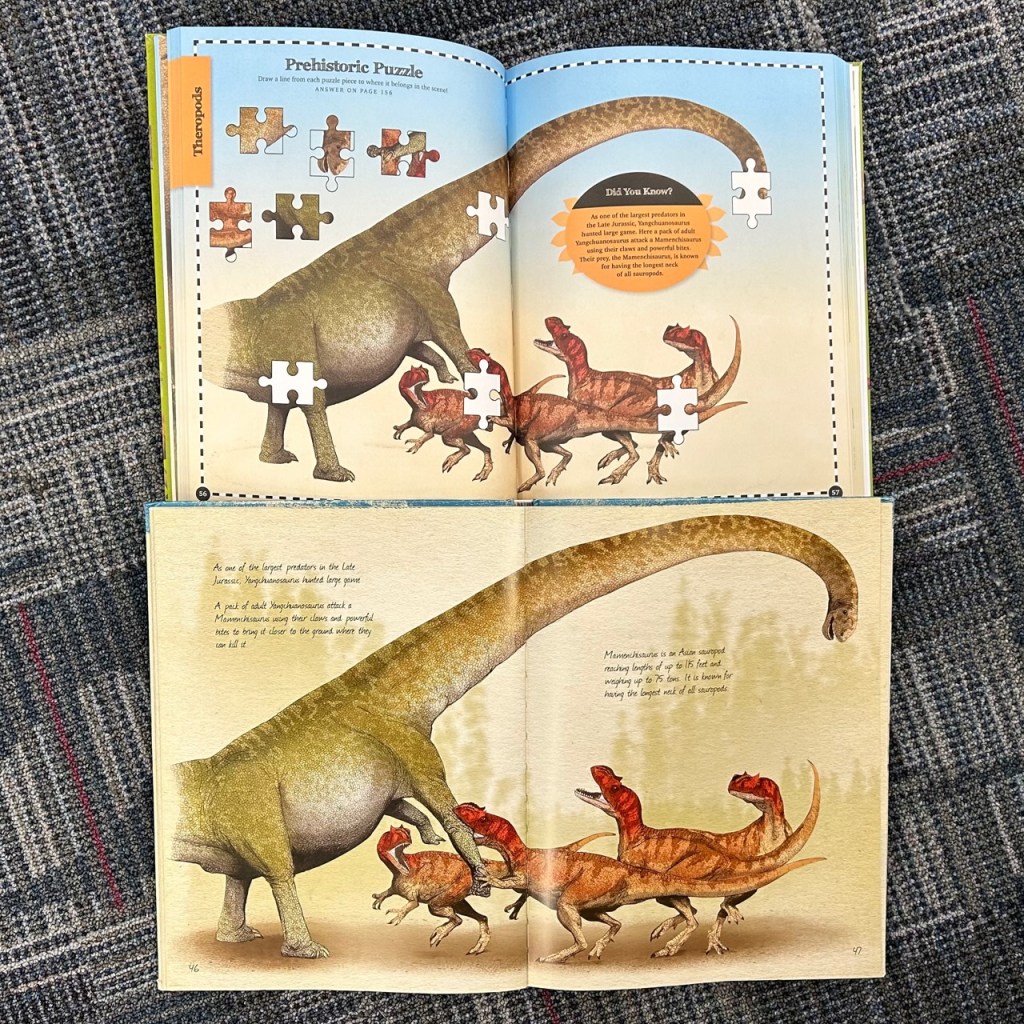
I once again feel like more diversity could have been shown, but was glossed over by the continued over-representation of theropods. Frustratingly, the book teases us with a Mamenchisaurus and some Dryosaurus, which are illustrated in the theropod section as prey animals, but do not receive their own profiles in the sauropod and ornithischian sections. Both of these are very different animals than their relatives, and would have greatly helped to impress upon readers the potential range of their respective groups.
I feel like the pterosaurs in this book in particular could have also benefitted from this treatment as well, as it features only two species. Tantalizingly, both happened to share their environment in the Solnhofen Formation with a dozen or so very unique other pterosaurs. (As for a book that does give them the star treatment they deserve, I recommend Beasts of Antiquity: Stem-Birds in the Solnhofen Limestone for more of these fascinating species.)
Jurassic Animals: Animal Encyclopedia Activity Journals
While presented as part of a separate series of activity books, Jurassic Animals: Animal Encyclopedia Activity Journal is actually a reformatting of The Late Jurassic, which is reprinted here in its entirety, along with some new content. In addition to a few new extra lines of informational text in the main journal entries, the different sections are now broken up by several pages of writing and drawing activities.
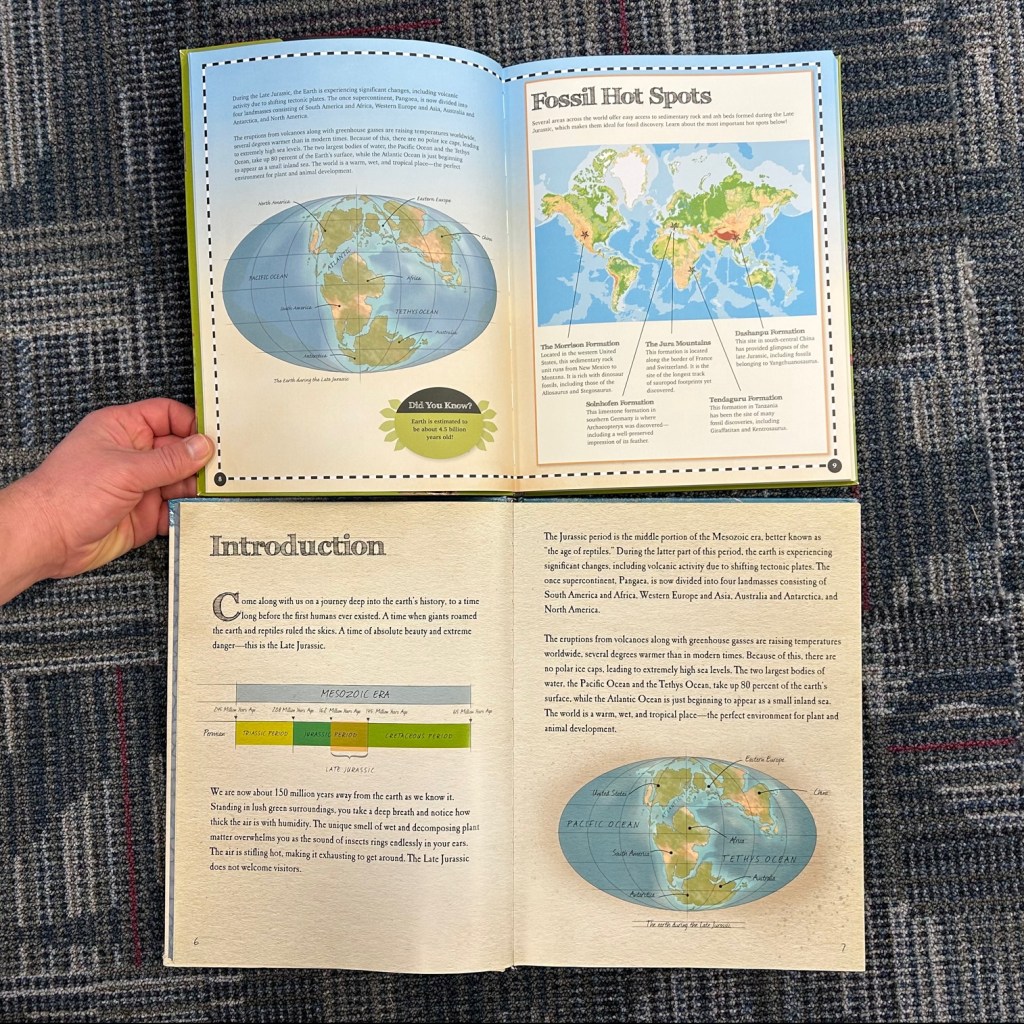

This would have been a good chance to elevate Dryosaurus and Mamenchisaurus to full profiles, but alas, they remain neglected. Beyond that, though, I don’t have any particular criticisms for the activity book. As it is a complete copy of The Late Jurassic, only with more content, I would say it is probably better value overall compared to its predecessor. The illustrations do perhaps look slightly better in the original, though, if that happens to be your main concern in collecting these.
Overall Assessment
I would say the Ancient Earth Journal books are pretty good, and pretty to look at, but they fall short of greatness. Alonso’s illustrations are fantastic, and the main reason to buy these books, but a few informational errors, along with a dearth of diversity, keep the overall value of the books from reaching the height they might have. I think they would have greatly benefitted from structuring them around locations rather than families. (See for example Europasaurus: Life on Jurassic Islands, and Did You Know Dino? Hell Creek.) There would have been more incentive to more evenly flesh out each group, and not relegate anything to throwaway “side characters”. I feel this would have also better played into the supposed “field journal” conceit that these books are ostensibly framed around, making them feel more like studies that were drawn from life, while watching the animals in their own environments. (Ironically, while not formatted as a “field journal” at all, I feel like When Fish Got Feet, Bugs Were Big, and Dinos Dawned comes much closer to that vibe that this series does.) So while I give these books a general recommendation, and I do hope to see more from Juan Carlos Alonso someday, I don’t think I can quite give these books as they currently exist my full Stomp of Approval.
 Dino Dad Reviews
I think that the classification of “Brontosaurus louisae” is unfortunately Greg Paul’s fault, as that is what he calls Apatosaurus louisae in the Princeton Field Guide of Dinosaurs. I checked and a lot of the lengths and weights of the dinosaurs in these books come from Paul’s Princeton Field Guide as well, so I think this information is probably proof of Paul’s involvement in this series.
LikeLike